Archive

Fiction

The Station Master – A ghost story

‘Station 20151207_161537Master! Station Master!’

The messenger banged on the door until the Station Master opened it dressed in his pyjamas and great coat. The messenger barely held in a laugh at how the man, who was an absolute tartar when working, looked so silly. He gabbled out his message.

‘German ships off the coast, Station Master. Heading this way. We have to stop the trains here, turn back any we can.’

‘Slow down boy. Tell me again.’

‘It’s the Hun. They’re coming up the coast. We’ve got to stop all of the trains, turn back any we can.’

‘Ok boy. You get on to Whitby, I’ll get organised here.’

The Station Master, being a kindly man if somewhat of a hard task master, sent his wife, children, maid and the station porter inland away from any danger. By the early hours of 16 December 1914 he was on the platform, still dressed in his pyjamas, coat and slippers, holding a red lamp out over the line. There were no trains due until 06:42 but war had played hell with timetables and there were often unscheduled trains through to and from the harbour. So the Station Master paced his platform, waving a red lamp. Soon he was standing, shivering and soaked through, at the end of the platform waving the lamp on the end of a long pole across the line.

The night was cold and wet. But he knew that the lives of anyone on any train passing through could depend on him so he carried on swinging the lantern through the cold. He carried on when the wind blew the rain sideways and drove it in to his uniform, chilling him to the core. He carried on when even though the wind blew so hard that he had to lean in to it to keep him upright. He knew that he could not move, even to go for a dry coat. And he’d sent away the only people who could take a turn or bring him dry clothes. So he stood there, swung the lantern, and waited.

The 06:42 was about two hours late. So the Station Master had been out for the best part of seven hours in the worst weather for a generation when it arrived. The driver saw the lantern swinging and stopped just short of the platform end. The Station Master stayed where he was, swinging the lantern. The driver and engineer shouted to ask what was wrong. When they didn’t get a response they finally climbed down from the warmth and relative dryness of the cab and walked over to where he stood. When they got there he was still waving the lamp. The driver touched him on the shoulder. He was dead. He had frozen in place and the lamp was only swinging because of the wind.

Sometimes, on December nights, especially when it’s windy, he can still be seen on the platform swinging his lantern.


In December 2015 I spent some time in the Station House at Ruswarp with a group of friends. This is one of the stories inspired by that visit – on a very windy night I sat and worked up the first draft, which was later amended to introduce the 1914 bombardment of the East coast in to the story.

Photograph and words (C) Chris Johnson 2015

I remember when this frame was new, shiny, silver plated. It had pride of place on the fireplace. My mother would take it down and polish off the nicotine and dust at least once a week. More often if someone was coming round. She bought it for her favourite picture of me. Taken at my cousin’s wedding in June 1950, I was wearing my first ever suit, a new hat, highly polished shoes. I’d been allowed to stand at the bar with the grown up men for the first time, allowed to smoke cigarettes and drink beer with them. Bitter tasting, warm and flat, it tasted like nectar to my seventeen year old self. It explains the crooked smile. My mother thought I looked grown up. I thought I looked drunk. We were both right.

My mother died in 1965. The frame went into a box. It was, lost, forgotten. No one wanted it any more. Not until one day in 1968 when my nephew, John, in bell bottom jeans and a tie-dyed shirt, found it while he was looking for inspiration for a university assignment. He wrote the assignment, passed and so kept the frame and my picture in his bedsit as a lucky charm. The room that was always full of loud music, the smell of pot, sweat and cheap beer. The silver plate got black in the thick smoke, the glass got covered with dust.

The frame moved around with John for another ten years. From his bedsit until his first divorce he kept it on display. In the early seventies cigar smoke replaced pot smoke, dinner party conversation and playing children replaced the loud music. By the late seventies his marriage had broken down and the sounds of arguments and screaming adults took over. The silver plate flaked. The picture faded. Eventually Amy issued the ultimatum and John took the easy route. He packed a bag and walked away. She dumped the rest of his belongings on the street. All but the picture frame. It sat, forgotten again, on the top shelf of a book case full of unread Dickens, Shakespeare and Chaucer along with a hundred Mills and Boone romances with broken spines and loose pages. A witness through her days of tears, sadness and endless David Soul ballads. Right through to the day when Amy started dating again. It was the new boyfriend who noticed it.

‘Hey, Amy, who’s this bloke?’

‘I don’t know. It’s one of John’s family I think. I’d forgotten it was there.’

‘He looks drunk. Shame this frame’s not real silver, it would have been worth something.’

‘It’s just a cheap thing. I’ll give it back to John.’

She put the frame face down on a telephone table in the hall. It stayed there for three months. Dark, dusty and ignored until John saw it one day when he was collecting the kids and Amy told him to take it.

John passed the frame on to his nephew, Julian. He was real eighties success story, a young millionaire trader in the city with a blonde girlfriend sharing his converted warehouse apartment. It sat on a shelf in the bathroom because Julian thought it was funny to talk to his Grandad, who told endless stories of austerity, while he was literally pissing away a fortune in overpriced champagne. During one of his parties someone thought it would be a good idea to snort cocaine off the glass. The party went on for days. The conversation fast and meaningless. The smoke as thick as it was in the sixties, the drug of choice and the price of the alcohol massively different. Then the market crashed, and so did Julian. The frame was taken from his repossessed apartment in the mid nineties and sold in a job lot to a second hand furniture dealer. Where it stayed. For two decades. It got moved from time to time. Picked up, dusted, put back somewhere new. But no one wanted to spend six pounds on a faded picture of a stranger in his first suit on his way to his first hangover in a battered frame with few patches of silver plate left.

At one of those dinner parties in the seventies one of John’s friends drunkenly joked that there was a tribe in Peru that believed that having their picture taken stole part of their soul. He found it hilarious. But it’s true. I’ve looked out from this frame for fifty five years. I’ve seen so much. And I’m ready for another change of scenery now. Please.

(c) Chris Johnson 2015

I can smell the wild garlic, the mown grass, the scent of a late summer. Mile after mile seems effortless as I run in the light of the full moon. Running is freedom, running is life, running because, not for, not to.

At least usually. Tonight I can hear them following. Sometimes they gain, mostly they drop behind. But never far enough. Tonight I’m running for, not because. And I’m not sure where to.

A cloud passes across the moon. I break out into the open, hoping for cover while it is darker. Sheep scatter. Bleating loud, they might as well be a siren call to my pursuers.

I hear the shouts behind. They’re forming into a pack. Getting clever. Soon one or two will try to outflank me. Then I’m done for.

I smell it before I hear it or see or hear it. A music festival. God knows why. It’s in the middle of nowhere. Still, a God send for me. Lights, people, smells, noise. And only about a mile away. I redouble my speed and head for the horizon.

Too late I realise that staring at the lights has ruined my might vision. I run flat out into a barbed wire fence. I land heavily, grunt. Cut and bruised. Blood trickles. Not good. I get back up and running, ignoring the pain, but I’ve given them another chance to catch up and now I’m leaving a trail.
Suddenly I’m there. I slink through the crowds. They’re concentrating on the stage, ignore me. I find a quiet spot. Hide behind a kebab van. Drooling with hunger, panting from the exertion and yes, I admit, shivering with fear.

I listen carefully, but there’s no sign of them following me. It’s not likely. Not into this noise, light, smells and number of people. They’ll wait until everyone’s gone. If I play my cards right I can follow the crowds back into the nearest town.

I eat, then change.

So the cycle starts again. I’ll be with people until they find out, then with wolves again until they smell me out.

A werewolf is never welcome anywhere. Not for long anyway.

Author’s note. The Y Not? Festival took place in Pike Hall, Derbyshire, on the same weekend as the blue moon on 31 July 2015. Which got me thinking… I took one liberty with this story, I’m pretty sure there are no wolves in the Peak District. Werewolves however; well, who knows?

(c) Story Chris Johnson 2015

(C) Picture Chris Johnson 2018

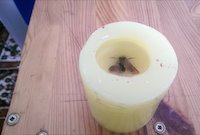
11898940_10153633488311095_2218785026502278564_nThe candle guttered as the breeze from the open window blew across the flame. The room was otherwise dark and silent, Charlie and Evie long having run out of conversation and retreated to their own thoughts. Charlie assumed that Evie was composing a poem. He had always envied her ability to ‘write’ in her head and only later commit to paper. He needed to see words on a page, to see what they looked like and to capture them before they were lost. He was thinking about money. Or lack of money. Hence the Friday night blackout. It saved on electricity. At least that was what Evie said. ‘With what we save on a Friday we can go out or have a take away on a Saturday, and anyway it’s a great way to come up with ideas and work on them’. Except it never seemed to end up that there was enough money left for a night out and he never came up with ideas that he could remember long enough to use.

Charlie knew that Evie was by far the better writer of the two of them. She seemed to turn her hand to any genre, sold articles and fake agony aunt letters and responses to the local papers and even had some interest from an agent for her unfinished novel. Not that they ever had any money, even with his part time wages and the money he managed to get from selling by the inch filler pieces on local clubs and societies to the local free papers, they still struggled.

A moth flew in and started to circle the candle. Charlie watched as it flew close to the flame, then further away only to be drawn back again. Evie gasped as it flew straight through the flame and trailed smoke as it circled a little wider for a while before, inevitably, being drawn back. Charlie just knew she was composing some deep meaningful poem. He tried to come up with some ideas himself. He could write about pilots in a dog fight. Something meaningful about how the pilots had more in common with each other than with the politicians who sent them to fight. He reached for the ever present notebook and pen, then realised that he couldn’t see well enough to write and Evie would never allow a light. Even so, he stared at the flame and started to plot the story even though he knew he would never remember it, hoping that something useful would remain somewhere in his subconscious.

Time passed. The moth continued to flirt with the flame and somehow just avoid being burned alive.

“Bed time.” Evie said. “Have you come up with any ideas?”

“A few” he lied.

“I’ve got a poem on the go. That moth was a brilliant inspiration, don’t you think?”

“I suppose.”

“Are you ok?”

“Yes, of course I am. Always.”

Evie went to bed. Charlie blew out the candle and closed the window before he followed her up. As he got into bed Evie recited some of the poem she’d ‘written’. She was using the moth circling the flame as a metaphor for a destructive relationship, subverting what appeared to be a love poem into something really quite dark in the final verse. It was genius. Charlie was devastated. Again.

Charlie dreamed. He was a moth and Evie was the flame he was circling. Every time he tried to get away she drew him back. But whenever he got too close he got burned. He woke with a start. Realising he would not get back to sleep he quietly got out of bed and went downstairs. The candle sat where it had been the night before. The moth was dead, its body preserved in the re-hardened wax. Before Evie woke he had packed and gone. Out into the darkness.


Photograph (c) Karen Downs-Barton 2015. Thanks to Karen for the writing prompt and kind permission to use her photograph. You can find her at: http://karendownsbarton.blogspot.co.uk/

Words (c) Chris Johnson 2015


She parks the van in a different place every night. At least once a week she’ll find a campsite and shower. In between times pull ins, car parks and quiet roadsides will do. Bathing in rivers and drinking from her carefully rationed wine stores. She sleeps with the doors double locked, the windows closed and the phone off. Avoids the radio, hides from the newspapers and hasn’t seen a TV, let alone watched one, for weeks. There’s a lap top hidden in the van somewhere, but she’s not looking for it.

No one knows her, her anonymity is closely guarded. Last week she tried to stay for two nights in one place and someone tried to make friends. That’s not the plan. She needs some time being no one and be nowhere.

All too soon she’ll be back. All too soon she’ll be Miss Brown, the art teacher. But not yet.

Author’s note: This story is part of a work in progress, a series  stories inspired by the people and places of the Peak District National Park.

(c) Chris Johnson 2015

“Pass me that spanner would you please?” Asked Vi’s disembodied voice from under the battered Mini. “And you may want to stand back a bit.”

I did as she asked, then moved back a few feet.

“Further!”

I stepped back a few feet more.

“ Little further!!”

And again.

Finally she pulled herself out from under the car.

“What are you doing all the way over there?”

“You told be to step back, then said ‘further’. Twice”

“Oh, sorry, the ‘further’ was me talking to myself about how far to tighten the nuts. She’s fixed now.

#

 “How did she get into this state?”

“A little run in with an anti-war protest. I was there to see Jimi Hendrix, nearly got myself stuck there. Could have been nasty.”

“And there’s no time for me to fix her up properly?”

“No, I’ve got a job on that’s pretty urgent.”

“So you’re an actual witness? That must be exciting. We don’t get many of you guys down here.”

“Yes, that’s me.”

“What do you do?”

“Well, you know the old philosophical question, ‘if a tree falls in the woods and no-one’s there to hear it, does it make a noise?’”

“Yes.”

“I’m there to hear it. For centuries archaeologists and historians argued about what actually happened in history, and in some cases whether anything happened. My job is to go and find out.”

“Is it dangerous?”

“Not if I stay on script and don’t get caught up the action.”

“So where are you off to now?”

“A minor war in Europe 5th Century by the modern calendar. I’m commissioned to witness the death of a minor noble who otherwise may have unified most of the Germanic world.”

“And you just turn up and seen him die?”

“Pretty much, a quick in and out.”

“Ok, I’ll just test run her for you and then you’ll be off.”

“I’m in a hurry. How long does the test run take?”

“Half an hour real time, maybe a bit longer.”

“Look, tell the truth, I stayed in 1970 a bit longer that I should have done. I went early to see Hendrix play before he died and kinda got sidetracked. Can I take her without a test?”

“No. But I can come to 5th Century Europe?”

“It’s strictly against the rules you know.”

“So’s taking an untested machine. First she goes back and forth on auto, then I take a ride, then you get her back. But, I’ve always wanted to see history. Real history. We’re only allowed to test drive these things to certain times, and even then we’re not allowed to stop. So there’s a deal there if you want it?”

“Ok, hop in.”

#

 I fiddled with the controls and set the trip computer for the correct time and place.

“Buckle up, we’ll be there before you know it!”

The first sign of a problem was when the year counter started to accelerate. The second sign was the noise. By the time the stars started accelerating past us towards a spot light years into the distance I knew that we were beyond control.

Vi looked across and shouted “Even I know this is not normal – what’s happening?”

“As far as I can tell the trip computer’s failed and we’re accelerating into the past.”

“At least it’s not something I fixed then!” Vi screamed. “What’s that?” She pointed ahead at the ever growing point of light.

“We’re heading into the ‘big bang’. Backwards!”

“Well, my philosophy on life was that I wanted to go out with a bang!” Vi laughed manically.

We both blacked out.

 #

 “Where are we?” Vi asked after we had both come round.

“I think the question is, ‘when are we?’”

“Is anything working on the time machine?”

“All the dials read ‘0’. But then, if we’re before the big bang, they would. The life support must still be working, otherwise I think we’re nowhere and nowhen.”

#

 There was an explosion. The battered Mini flew at an enormous rate out from the pinpoint of light.

“How far into the future do we need to go for you to be able to fix this?” I asked Vi.

“A few tens of millions of years…”

“Oh well, by the time we get there you’ll have witnessed a lot of history. Might as well sit back and enjoy the ride!”

Author’s note. This is not a ‘fan fiction’ but there is more than a touch of ‘Dr Who’ and more than a touch of Connie Willis’ ‘Blackout’ in the inspiration for this story. I am indebted to both.

(c) Chris Johnson 2015

“Hey, wake up. I’ve got a story for you.”

“Hmpff, get off, I’m asleep.”

“No, it’s great, there’s this character from one of your stories story who keeps complaining you’re writing her parts too one dimensional.”

“I’m asleep”

“You’re awake now. You might as well listen. Get your note book out, it’s a great story.”

“A story about a character, that is someone I made up, that doesn’t think I’m telling her whole story…I guess it’ll keep my therapist happy if no-one else!”

“Yeah, be cynical. It’s a great story – a series of stories actually – she’s a recurring character, comes across as a real hero, saves the day, the lot. Only really she’s horrible, really nasty, not just an anti-hero – actually a real bitch.”

“What?”

“And she wants you to tell her all of her story your next comic. With the extra plates, the ones showing her torturing and killing.”

“Hang on, I can understand the challenge that I’m making characters in short stories pretty one dimensional. Sometimes that’s all that’s needed. I can accept the challenge that I’m only telling part of a character’s story, I’m writing flash fiction not epic novels. But now I’m being accused by one of my characters of not making her a big enough bitch in a story I’ve never written, in a form I don’t write?!”

“But it’s a great story…hang on, what do you mean you don’t write comics and you don’t recognise your characters? What day is it? Isn’t it full moon?”

“No”

“Ah, my bad. As you were.”

“I’m awake now!”

“Sorry. You know how it is, cut backs, there aren’t enough muses to go around so we have to double up. I must have just opened the wrong link on my browser. Brought you someone else’s inspiration, as it were.”

“So that’s why I have days on end when one story sticks in my head and won’t let any others out – you’ve got me on some sort of muse holding service!”

“Err, yes, it’s like an answering machine message – you know, work on this one until I can get back to you. Anyway, I’d better take this story where it belongs.”

“Wait, don’t be so hasty. How does this character feel about being a pulp fiction heroine? I think I have an idea!”

“Oh dear, I’m in trouble now…”

(C) Chris Johnson 2014

“Angie! Angie, wake up!”

Towelling his wet hair, Grant walked into his bedroom.

Grant reached down to shake her. He really wanted her to leave before his house mates woke. He told himself it was to protect her reputation, in truth it was probably more about his. Like a number of newly qualified doctors he was older than the student nurses he often drank with and was well aware that a reputation could badly impact on his future employment prospects.

He touched Angie’s shoulder. It was cold. He pulled his had away, she rolled on to her back. That’s when he saw the blood on the pillow, dribble from the corner of her mouth.

Grant stood stock still for what seemed, to him, to be hours. Then he grabbed a bag, filled it with some clothes, found his passport, phone and wallet and headed out of the house.

***

An hour later blue lights strobed across the front of the house. Grant’s housemates stood around waiting for the police to tell them what to do. Grant was at the ticket desk at St Pancras praying that he could get on a Eurotunnel train before the police got his name and address on some watch list. He succeeded. He travelled fast, Paris, Mediterranean coast, North Africa, on and on further South into sub Saharan Africa. Days later, tired, hungry, dirty and unshaven he washed up at a refugee camp. Giving a false surname, he volunteered to help in the field hospital.

He used the internet terminal in the hospital office once a day to check for any news. By the time he’d arrived at the camp the main story, the death of one student in another’s bed had already been archived. The only news story that appeared to be updated daily was the search for him. He swore to himself not to go back.

Six months passed.

Grant stepped out of the operating theatre and into the shower tent. Wet, refreshed, he looked in the only mirror on the camp. A tanned, bearded and haggard man he barely recognised looked back.

Soon afterwards Grant’s boss offered him the chance to work even further into the interior of the desert. After six months there he moved on again, then again, then again. He carried on running from his own past, concentrating on his work. Forever moving to the next trouble spot, never taking any payment except for food and board.

Time passed. The man in the mirror’s beard bleached blonde in the sun, his hair grew first long, then bleached the same colour as his beard. He still occasionally checked the internet. It was clear that the police had stopped actively searching for him, but he was on a number of missing persons databases. He’d never seen anything indicating that Angie’s murder had been solved. He was sure he was still a suspect. He wasn’t sure that in some, unspecified way, he was guilty.

***

Grant’s boss found him one day, taking a nap in an otherwise empty dormitory tent.

“Grant, I need you to go to the UK on a fundraising lecture tour.”

“No.”

“I need you to go. You’re intelligent, erudite and most important you could earn a good living in the UK but you’ve chosen to be here. It’s a story we want to cash in on, it’s a great recruiting tool.”

“No.”

“Grant, I’ve been suspicious for a while that you’re running from something. But please, reconsider.”

“I have no passport.”

“We’ll get you one. Any name you want.”

“You can’t do that.”

“We do it all the time. We get passports for loads of refugees. What’s one more?”

Grant realised he had been cornered. “Ok.”

***

“Sir?”

“Yes, PC Hains?”

“Sir, we’ve got a hit on an old case. Facial recognition on CCTV at Heathrow.”

“Let me see.” He looked over the PC’s shoulder. “That is an old case. Ok, track him and bring him in to a local nick.”

***

The hotel manager opened the door to Grant’s hotel room at dawn, the PC with him was obviously wary as he entered the room. Grant was awake, reading his presentation for that day at the small desk in his room.

“Sir, please stand and turn to face me.” The PC said.

Grant’s shoulders drooped. His head too. “Ok” he said, and did as he was told. “Am I being arrested?”

“No sir, I’ve just been asked to take you to the station. Someone wants to talk to you.”

***

The interview room was something from Grant’s worse nightmare. After years of desert life and refugee camp hospitals, the damp, dark room felt like a tomb. An overweight balding man in plain clothes, escorted by the PC who had brought Grant in, came in to the room. Sitting, the detective checked Grant’s name and confirmed his address at the time of Angie’s death.

“Where have you been Grant?”

Grant told the short version of his story.

“You’ve been on the run?”

Grant nodded.

“From what?”

“The girl in my bed was dead. I am a murder suspect. You’ve never caught anyone as far as I can tell. I’m fairly certain I didn’t do it, but I was very drunk. Anyway you probably think I did?”

“She was murdered?” the detective asked.

“Yes…wait”, Grant frowned, “ I never checked. The internet news stories never actually said murder. I just assumed.”

“Some doctor you are. Didn’t even check. For God’s sake never work on me. Off you go.”

“Wait? What? I can go?”

“Natural causes. She died of natural causes. You would have been back at college that afternoon with a story that you could have dined out on for life. Goodbye Grant, good luck with your lecture tour.”

As he walked back to his hotel the early commuters gave Grant a wide berth as his laughter turned to massive, loud, sobbing tears.

(C) Chris Johnson 2013